
Adjusting to Technology
(and Retirement)

Recently, just after giving a writing prompt—write about a breakthrough that caused new problems—my phone blew up with notifications. Two back-to-back texts, a phone call from an unknown caller that went to voicemail. I continued speaking to the group, getting them safely into the timed writing before I checked my phone.
I hate being interrupted, especially if I am deep in thought or focused on a creative project. But my mind was racing. Was there something urgent from my son in California? Was it my 96-year-old mother calling? Was it my sister calling with something about Mom?
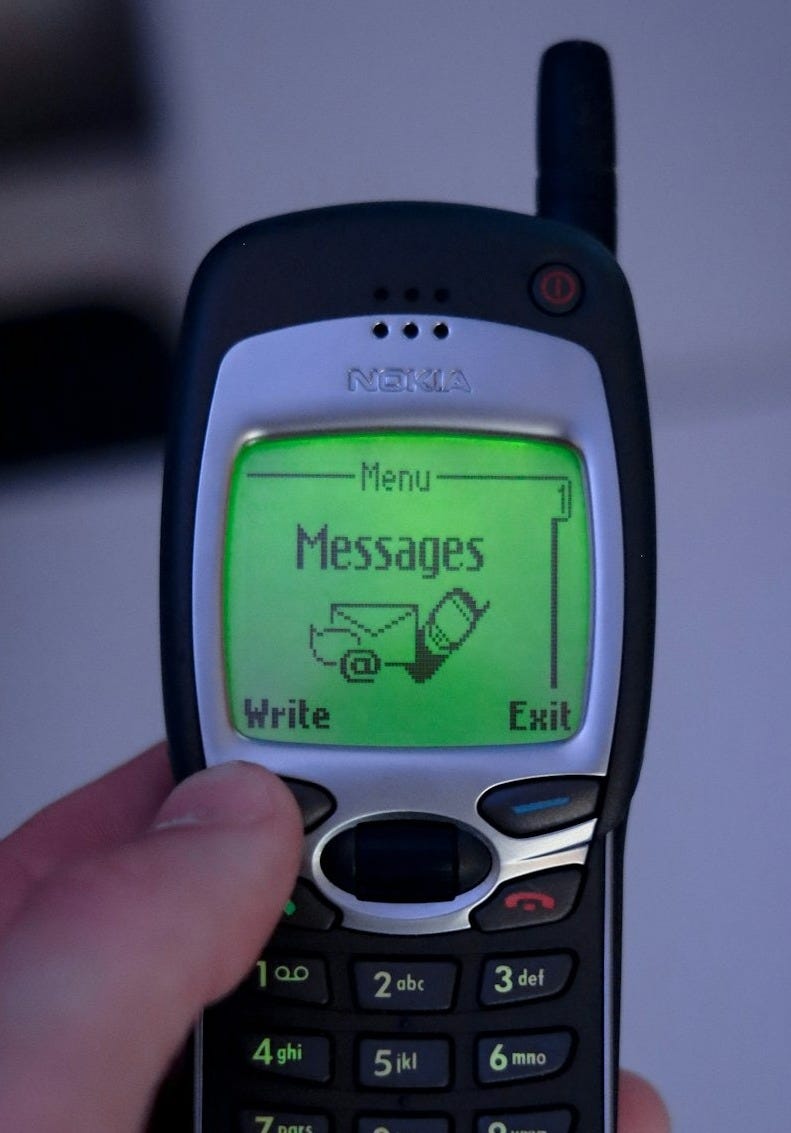
No, it was my ophthalmologist’s office telling me I hadn’t scheduled a follow-up appointment. I’d been there two months earlier, and I needed a six-month follow-up, but their calendar didn’t go out that far. They promised to send a reminder when the calendar opened up. The gentle reminder I envisioned was not an assault of four simultaneous notifications on my phone. I didn’t imagine it arriving in the middle of something important. Yes, I could have set the phone aside, but I needed the timer app to time the writing.
Lesson learned. Now I put my phone on silent mode during workshops, and I keep it face down. This wasn’t a particularly painful life lesson, just a single, laughable moment, one small symptom of how the convenience of a cell phone can go astray, how the constant interruption of our lives stops deep thought and reflection unless we put strong boundaries around this handheld piece of plastic, metal, and rare earth elements.
I got my first cell phone from my employer, a hospital system, when I was forty years old. I sat in my cubicle surrounded by other doctors. Our office manager walked in with four boxes, one for each doctor.
“Here you go. The clinic budget is paying for a cell phone for each of you. Let me know what number got assigned to you, and don’t forget to set up your voicemail inbox.”
We opened them right away and began thumbing through the tiny owner manuals. I welcomed the convenience. Now I could go out to dinner while on call without having to search for a phone if the answering service beeped me. I saw only positive aspects. I didn’t see myself using this phone for anything else. Over time, I ditched my beeper when the answering service began texting. Then the incoming calls began. The answering service called if we didn’t respond to the text right away, other doctors got our phone number from the hospital operator.
Eventually, the phone became an indispensable companion. As a full time doctor, I didn’t have the luxury of silencing notifications, of ignoring calls from unknown callers. But even when I was (always) on call, I tried to hold some boundaries. Once, at three a.m., a patient called me. She was driving home from New York City, and she wanted to share good news about her visit with her incarcerated son.
Instead of sharing her joy, I was stern with her.
“Maria, I’m happy for you, but it’s three o’clock in the morning. You woke me up. This is not an appropriate use of the answering service.” She was immediately contrite and apologetic. I wasn’t sure if I was angrier at her impulsiveness or at the answering service that failed to screen her call.
I had a marked reduction in text messages when I stopped seeing patients in the hospital. That was a drastic response to a huge drain on my wellbeing. But I wasn’t as good at holding boundaries with my colleagues. Once, as I took an afternoon walk, I answered a call from a doctor who was always on call for his solo, private practice.
“Jeff,” I said, “I’m not on call.”
“I know, but you know this patient better than the on-call doctor does.”
I lived the chronic guilt of the medical culture. I was supposed to sacrifice my time for the sake of my patients.
Even after three months of full retirement, keeping the phone with me is a hard habit to break. I could put my phone in another room at night, rather than sleep with it at my bedside, but it feels wrong. Someone may need to talk to me. As a doctor and as the mother of a child (now an adult) with a chronic illness, certain worries become ingrained.
But I could try to wean myself. My son has other resources now. I’m getting used to not being a doctor anymore. There is a line from a Robert Bly poem that never fails to bring tears to my eyes. The poem is “Things to Think,” and the line is “…it’s not necessary to work all the time, …it’s/Been decided that if you lie down no one will die.” I get tears because these words remind me of when they were not true. Sometimes, when I was on call, if I lay down and went to sleep, someone would die.
Scroll down to the bottom for the weekly Poem + Prompt!
Half Magic #2: September 8, 2025, Summer Monday Week #4
When I was in fourth grade, one of my favorite books was Half Magic from Edward Eager’s Tales of Magic Series. Four siblings find a coin in the street, which, when wished on, gives them half of what they wished for. To get a full wish, they have to wish for double what they want. It’s a great premise.
What I offer here is half the magic of attending one of my workshops. I’ll link you to a poem and then give you a writing prompt. If you want, you can set a timer for twenty minutes and write something. I’ll also offer a sample of something I or one of my workshop participants wrote in response.
This may not feel magical, but that’s because you’re missing the other half. When you hear yourself read your freshly written words aloud to a trusted group, and then hear them echo back to you what’s strong and good about the writing, that’s the magic of becoming a better writer.
Poem: “Lockdown at the School for the Deaf” by Sara Novic
Prompt: Novic says: “in trying to give him keys, we’ve only changed the locks.” From memory or imagination write about a breakthrough that caused new problems.
Response: As you may have guessed already, the post above, “Adjusting to Technology (and Retirement),” was written in response to this poem and this prompt.
If you liked this post, please make it more visible to others: comment, like, or restack.
If someone forwarded you this newsletter and you’d like to subscribe, you can do that here.
Thanks for reading,
Deborah
I had to laugh at the memory of cell phones being a status symbol in the early days. Maybe it was the politics adjacent places I worked but it was common practice that meetings and lunches started with each person putting their phone on the table. It was mainly for show--there just weren't that many people to call or who could call you. Always made me think of old-west gunslingers (and yes--it was mostly men).
Deb, oh my goodness, I can relate to this so much. I always feel like if I don’t take the call, it’s going to turn into a bigger problem later. It’s like I’m constantly carrying the weight of my phone with me. I definitely need to work on setting better boundaries!